
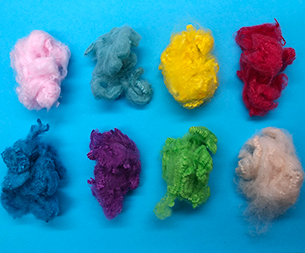
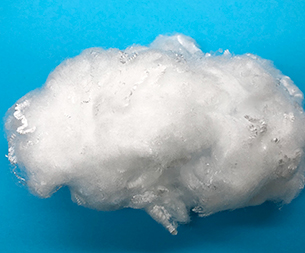
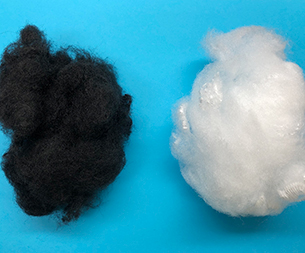
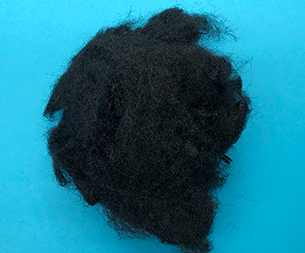
In the current field of industrial materials and construction engineering, PP staple fiber is playing an increasingly important role. As a type of short-cut fiber produced by melting and spinning, cutting and other processes from polypropylene resin, it is becoming an ideal choice for multiple industries due to its unique physical and chemical properties.
From the perspective of material properties, the advantages of PP staple fibers (also known as PP staple fibers or polypropylene short yarns) are quite prominent. Its density is only 0.91g/cm, making it a lightweight material. Its chemical properties are quite stable and it has extremely high acid and alkali resistance, which means it can adapt to complex construction environments. In concrete and mortar applications, PP short fibers, through their physical micro-reinforcement effect, change the internal structure of the material. Countless single fibers are evenly dispersed in the cement matrix, effectively restraining the development of micro-cracks caused by plastic shrinkage, drying shrinkage and temperature changes. This improvement in crack resistance also indirectly enhances the concrete's impermeability, freeze-thaw resistance and impact resistance.
In terms of application fields, PP staple fiber covers a wide range. In construction projects, they are often used as secondary reinforcement materials, such as in basements, tunnel linings, bridge surface paving, and water conservancy projects, which help enhance the durability of the main structure of the project. At the same time, it is also an important raw material for geotextiles, taking advantage of its corrosion resistance and strength, and playing a filtering and reinforcing role in highways, railways, and slope protection projects. In the industrial textile products field, PP short fibers are also applied in automotive interiors, carpet backing, filter materials, and medical nonwoven fabrics.
With the advancement of technology, the product line of PP staple fibers has been continuously enriched. Besides the conventional models, differentiated products such as those with UV resistance and flame retardancy have also emerged in the market to meet the engineering requirements in special environments. It should be noted that PP short fibers do not alter the chemical composition of concrete during construction, so they will not have adverse reactions with admixtures. They can be used directly by simply dry-mixing evenly with a forced mixer.
Jiangsu Haibang New Materials Co., Ltd., formerly known as Taizhou Hailun Chemical Fiber Co., Ltd., is a technical-oriented chemical fiber enterprise specializing in the research, production and sales of polypropylene staple fibers. The company has two factory sites in Taizhou City, Jiangsu Province (18 kilometers apart), covering a total area of over 100,000 square meters, with 50,000 square meters of factory buildings and over 10,000 square meters of office space. The company has 9 advanced fully automatic polypropylene staple fiber production lines, with an annual designed production capacity of 90,000 tons. The company has established a complete polypropylene staple fiber testing laboratory, equipped with a complete set of fiber testing instruments, and possesses the ability to develop new products for polypropylene staple fibers.
- Industrial Supporting Refinement Upgrades, Polypropylene Staple Fiber Breaks Universal Limitations for Specialized Matching
- Industrial Production Accelerates in September|Jiangsu Haibang New Materials Consolidates Non-woven Industry Supply with Polypropylene Staple Fiber
- Evolving Demands of Technical Textiles Drive Custom‑Functional Development of Polypropylene Staple Fiber
- Polypropylene Staple Fiber for Diverse Downstream Industries, Functional Chemical Fibers Boost Technical Textile Upgrading
- Expanded Downstream Segments Push Polypropylene Staple Fiber Toward Functional Customization
- Polypropylene Staple Fiber, Versatile Base Chemical‑fiber Material for Industrial Textiles
- Polypropylene Staple Fiber Industry Advances Steadily as Differentiated Applications Drive Service Improvement
- Polypropylene Staple Fibers Support Industrial Growth — Jiangsu Haibang New Material Earns Market Recognition Through Quality
- Functional PP Staple Fiber Expands Application Coverage, Upstream & Downstream Chemical Fiber Industries Upgrade Simultaneously
- How to Choose PP Staple Fiber for Procurement? Selection Guide for Multi-Field Fiber Raw Materials
- Markets
- Automotive Products
- Nonwoven Lining
- Geosynthetics
- Liquid Filtration
- Apparel and Textiles
- Hygiene Products
- Building and Construction
- Other Markets
- Contact Us
- Contact Haibang